I'm going to say something that's going to make every veterinary surgeon in America furious.
Because what I found — and what I built from it — could cost them billions.
But I don't care.
My daughter watched our first dog, Max, disappear over three years.
It started with small things. A shorter walk. A skipped stair. A ball he watched roll past instead of chasing — the same ball he'd have gone through a wall for a year earlier.
Then his knee gave out. Then the surgery. Then the complications, and the second surgery on the other leg, and the long crate months that took the light out of him entirely.
At the end, he couldn't stand up to greet her.
My daughter buried her face in his fur that last afternoon and made me a promise I've never forgotten:
"Promise me you won't let that happen to Scout."
Eight years later, it started happening to him.
THE EVENING I STOPPED PRETENDING
Scout is my yellow Lab. Nine years old that summer. The kind of dog who heard the leash from three rooms away. Who took the back stairs in two jumps his whole life.
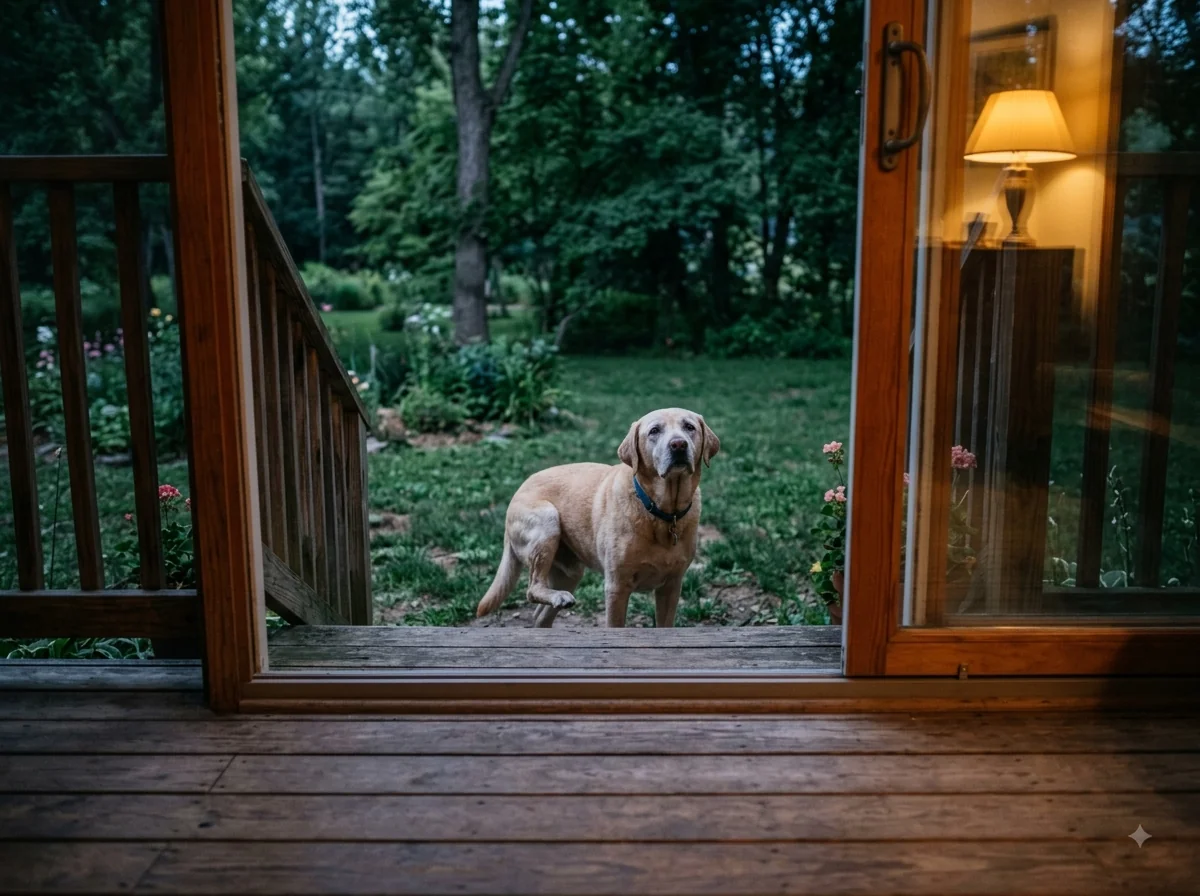
Then one Thursday evening at 6:43 PM, I clipped on his leash, opened the door — and he didn't come.
Not sniffing. Not distracted. Just standing there.
At the bottom of the porch steps.
He'd been lying on the cool kitchen tile all afternoon. When he finally got up, his back right leg hovered — toes just brushing the floor. He took the first steps like the ground was made of glass. And at the stairs — his stairs, the three steps he'd cleared ten thousand times — he stopped.
And he looked up at me.
Not a hesitation. Not a pause. A calculation. A dog doing math on three steps.
He tried anyway, because Labs always try.
His leg buckled on the second step.
He caught himself, hopped up the rest on three legs, and wagged at me from the top.
Like he was apologizing.
I'm a certified canine rehabilitation specialist. I've treated more than 9,000 dogs. I've sat across from thousands of owners and delivered news that broke their hearts.
And I stood on my own porch, holding a leash, completely useless.
The one dog I'd promised to protect. The promise my daughter made me hold with her face buried in Max's fur eight years earlier.
I wasn't keeping it.
If any of this sounds like your dog...
If you're reading this at 2am because you just googled "dog limping back leg when to worry"...
If your dog holds a leg up after fetch. Takes the first steps after a nap like the floor is ice. Licks the same knee every single night until the fur is stained.
This isn't just slowing down. It's getting worse. And somewhere inside, you already know that.
If walks have quietly gotten shorter because you can't stand watching the limp. If your dog stands at the couch — their couch — and doesn't jump. If you've started lifting them into the car and they let you, because they've stopped trusting that leg too.
If the dog who never let you out of sight now thinks twice about following you upstairs — and it breaks something in you every time...
The next 5 minutes could change everything.
That evening I stopped pretending I had the answers and went looking for the ones nobody was giving dog owners.
WHAT I FOUND MADE ME WANT TO PUT MY FIST THROUGH THE WALL

The entire canine joint-care industry is built on a lie. And that lie is costing your dog his best years.
$38 billion. That's what Americans now spend on veterinary care every single year.
For a failing knee ligament, the system offers two answers. Surgery costs
$4,850 per knee on average. Lifetime pain medication runs
$1,200.
a year — with bloodwork every few months to watch your dog's liver and kidneys.
Neither one helps a dog whose ligament hasn't fully torn yet. And even then — even for the dogs surgery was designed for — the results come at a price. Complication rates up to one in five. Twelve weeks of crate rest. And up to half of dogs eventually blow out the other knee and do it all again. At
$4,850 per knee. With a bone saw.
But if your dog is in the early stage — the stage where the limp comes and goes. Where he's fine mid-walk but stiff after every nap. Where she still chases the ball but pulls up early and licks her knee all evening — your dog is actually in the most critical phase of all.
This is the window. The phase where the damage can still be reversed.
Where the ligament hasn't torn. Where the right support can pull the joint back before the line gets crossed.
And what does the system offer your dog at this crucial moment?
Nothing.
Restrict activity and come back if it gets worse.
That's what I told dog owners for 20 years. I meant it kindly. I had nothing better.
Because here's what the industry doesn't want you to know:
Most hind-leg trouble in dogs over 6 isn't arthritis. It isn't hip dysplasia. It isn't "just getting old." Not usually.
It's one small ligament in the knee, quietly stretching — a millimeter at a time.
THE REAL CAUSE — YOUR DOG'S KNEE IS FAILING IN FOUR STAGES
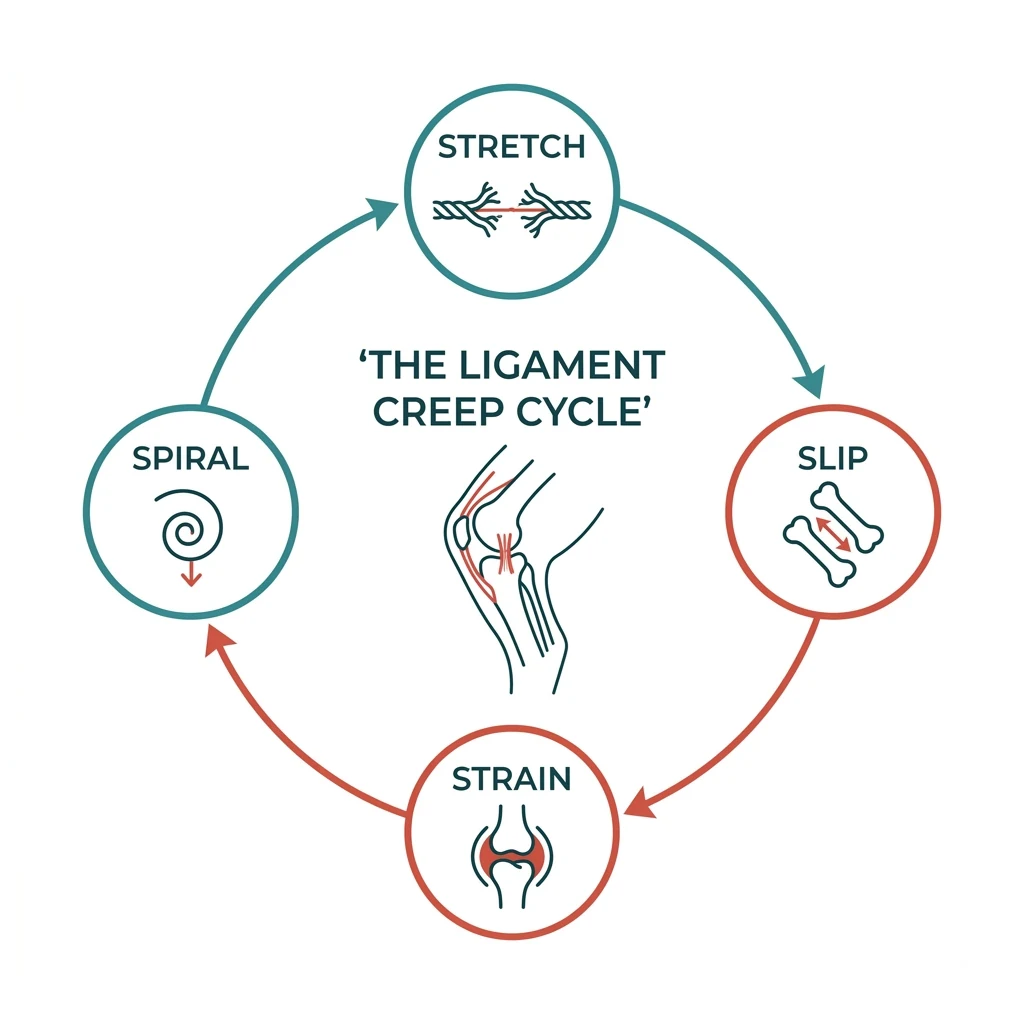
Here's what nobody at the clinic has time to explain.
Your dog's knee doesn't fail all at once. It fails in a cycle. Four specific stages — each one feeding the next — and when any one of them breaks down, the whole leg suffers.
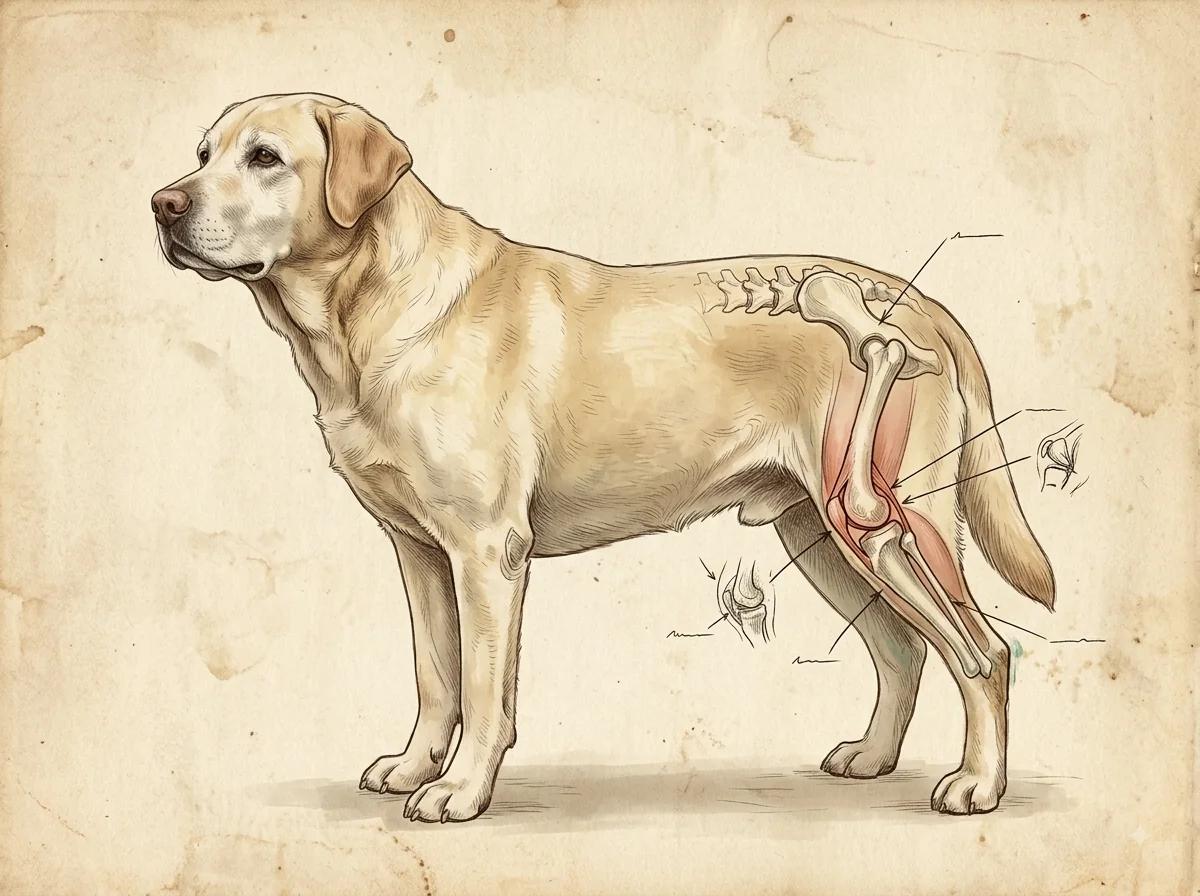
Stage 1: STRETCH. Your dog's knee is held together by one small ligament — the CCL, the canine version of your ACL. Every jump off the couch, every sprint for the ball, every skidding turn loads it like a rope. After age 6, that rope starts to fray and stretch — a fraction of a millimeter at a time. Vets call the process ligament creep.
That's why the first sign isn't a yelp. It's stiffness after a nap. The careful first steps in the morning that "work themselves out" by the end of the driveway. That's the rope quietly lengthening.
Stage 2: SLIP. Once the ligament stretches, the two leg bones it holds start to slide against each other with every single step. The joint is now unstable. Your dog feels it long before you can see it.
That's the limp that comes and goes. Fine one day, hopping the next, fine again by the weekend.
Stage 3: STRAIN. The body notices the instability and floods the joint with inflammation, trying to splint it from the inside. The knee swells and aches. Your dog starts shifting weight off that leg — every hour of every day.
That's why your dog licks that same knee every night. That's why she stands at the bottom of the stairs and calculates. That's why the couch — her couch — suddenly isn't worth the jump.
Stage 4: SPIRAL. The sore leg does less, so its muscle wastes away. The "good" leg does double duty — and its ligament starts stretching too. This is why up to half of dogs who injure one knee injure the other within two years. The cycle doesn't stop on its own.
That's why the limp keeps coming back. Why some weeks are better than others. Why nothing you've tried ever seems to hold.
This is the 4-Stage Ligament Creep Cycle.
And here's the thing that should make you furious:
Every fix you've been offered only addresses one stage.
Pain pills mask the Stage 3 swelling. Crate rest slows the Stage 2 slipping — while the muscle your dog needs wastes away. Joint chews feed cartilage the problem isn't even in.
The chews. The fish oil. The "senior dog" formula in the brown bottle. One link of a four-link chain — and never the ligament itself.
That's not incompetence. That's a business model.
A worried owner who keeps trying and failing is a customer for life.
I decided I was
done.
THE EIGHTEEN MONTHS THAT CHANGED EVERYTHING
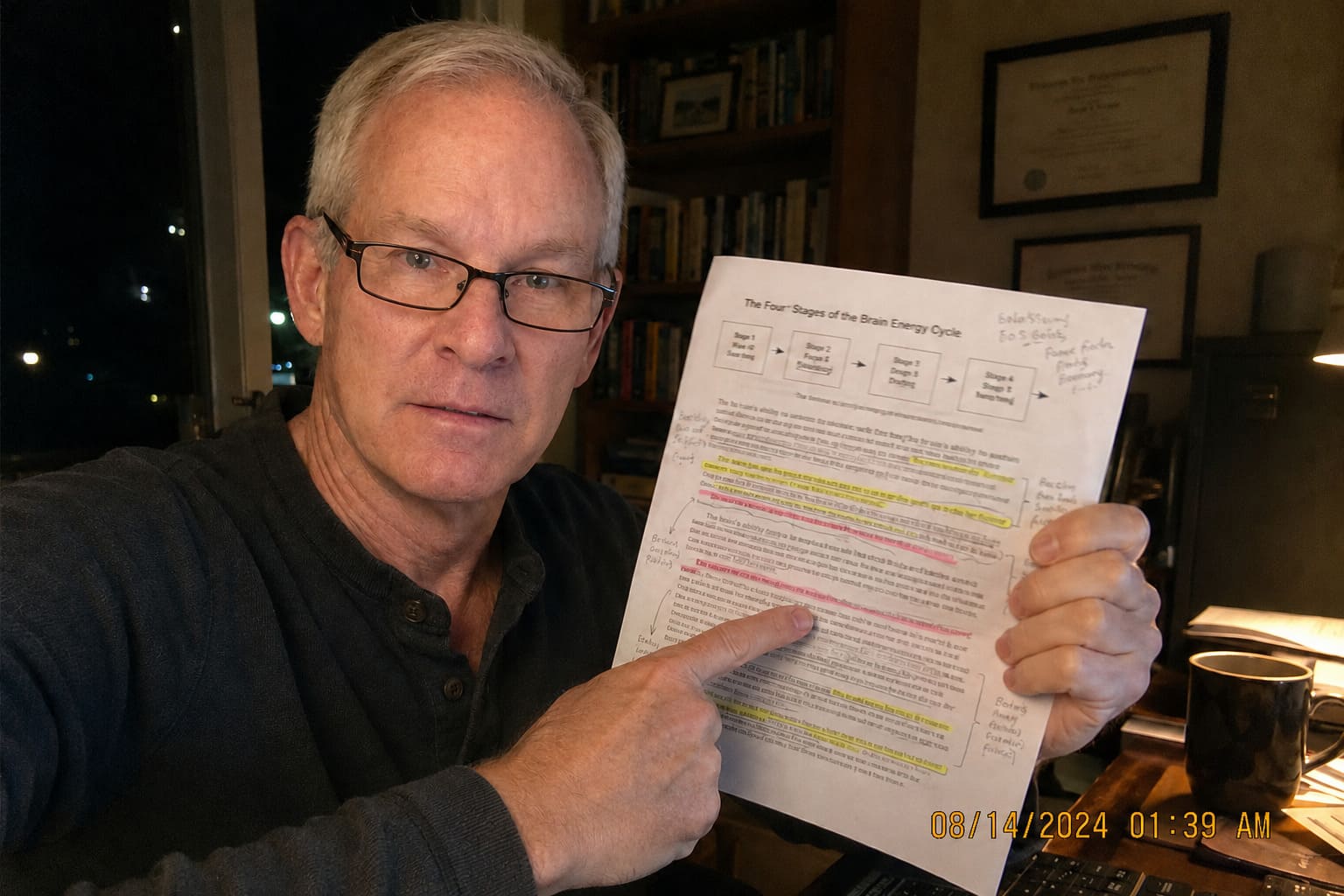
I went through every published study on canine cruciate disease. Called every rehab specialist and orthopedic researcher who'd run real trials on non-surgical management.
I was looking for mechanisms — one for each stage — that met four criteria: real orthopedic evidence, completely drug-free, comfortable enough that a dog would actually wear it every day, and safe for a senior dog already on other medications.
We built and tested dozens of prototypes on my own rehab patients.
Most failed one criterion. Many failed three. A handful showed real promise — but only for one stage.
Only four mechanisms passed every test. And nobody had ever put all four together — in one piece of equipment, in a form a dog would happily wear every single day.
The first version was a rigid single-leg splint. Scout wore it for sixteen days. Real results. Then he started hiding under the desk when I picked it up.
"He walks like a robot," my daughter said. "Every time you strap it on, he stops being a dog."
So I built something dogs forget they're wearing.
INTRODUCING DYNAPAW — THE FIRST BRACE BUILT FOR THE FULL CYCLE
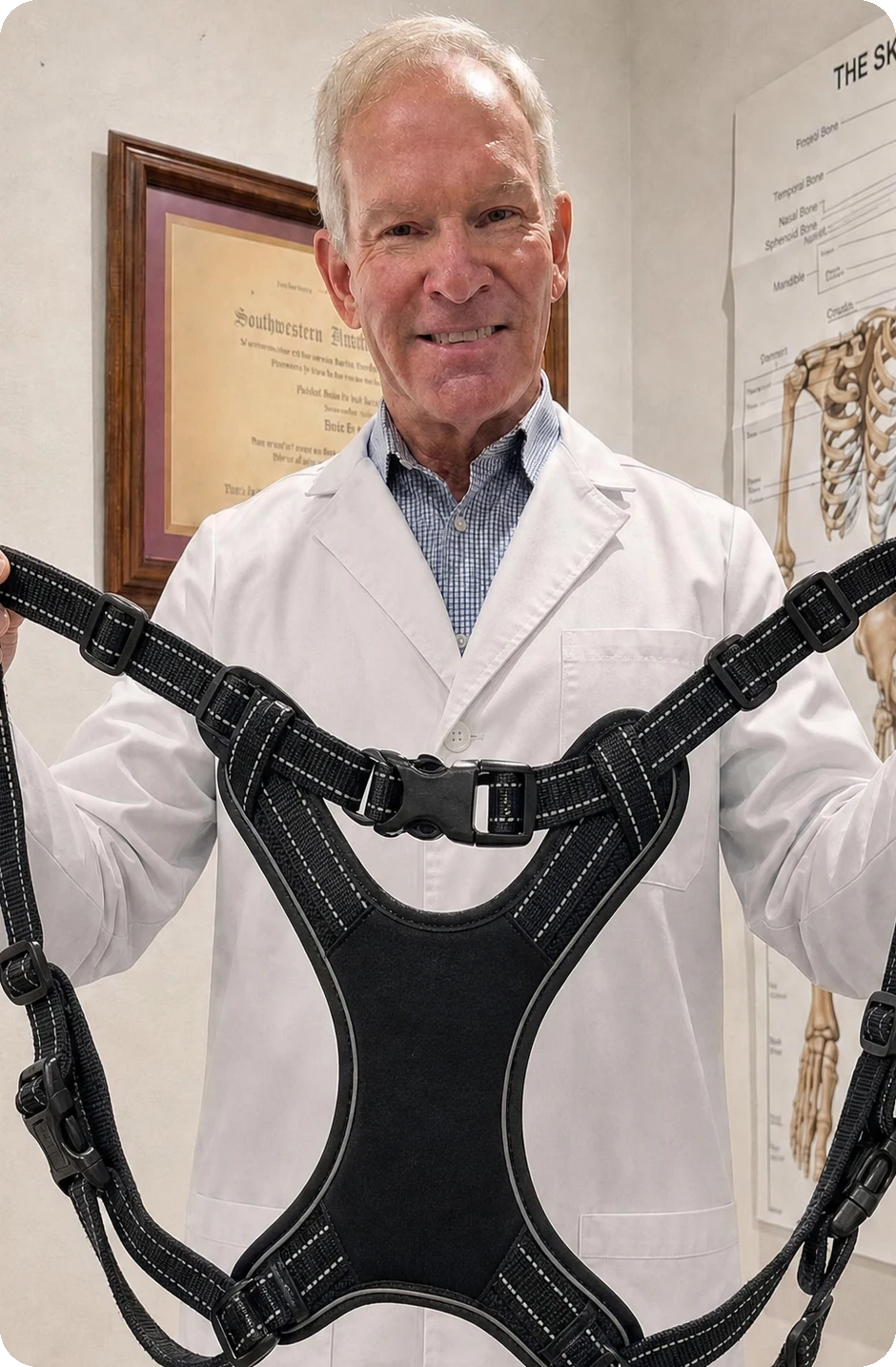
One dual-leg support system. Two minutes to strap on. Worn for walks, stairs, and play — off at night.
No drugs. No sedation. No crate rest. No surgery.
Here's what's in the design — and exactly what it does:
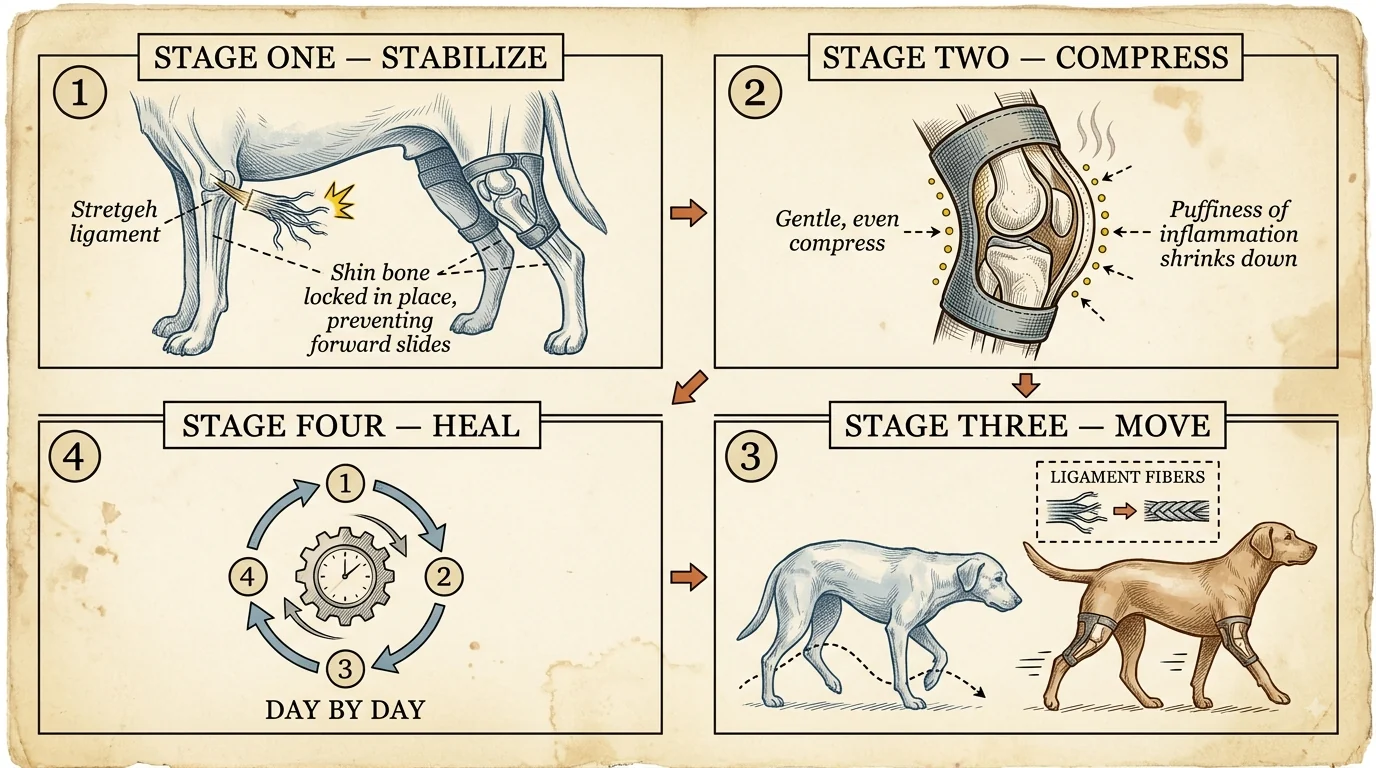
STABILIZE — Dual-Leg Joint Stabilization Two connected supports lock both knees into their natural alignment, so the bones stop sliding with every step. And because it supports the "good" leg at the same time, it breaks the overload spiral that takes down the second knee. Single-leg braces skip this entirely — which means they skip half the problem.
COMPRESS — Targeted Medical-Grade Compression Calibrated pressure zones around the joint boost circulation and move inflammation out of the knee instead of letting it pool there. The swelling goes down. The ache goes with it. No pills, no liver panels, no side effects.
MOVE — Full-Motion Freedom Unlike rigid splints and crate rest, DynaPaw lets the joint travel through its natural range while protected. Muscle keeps firing on every walk. Strength stays. That's the difference between resting a leg and rebuilding one.
REPEAT — The Daily-Wear Healing Window Ligament fibers rebuild in response to consistent, protected load — not to rest. Worn during activity and removed at night, DynaPaw holds the joint in that healing zone day after day. Over six weeks, the fibers heal shorter and tighter instead of longer and looser.
Four stages. Four mechanisms. All four — working together — in one brace.
This is the architecture every other brace missed.
THE RESULTS THAT GOT MY COLLEAGUES CALLING
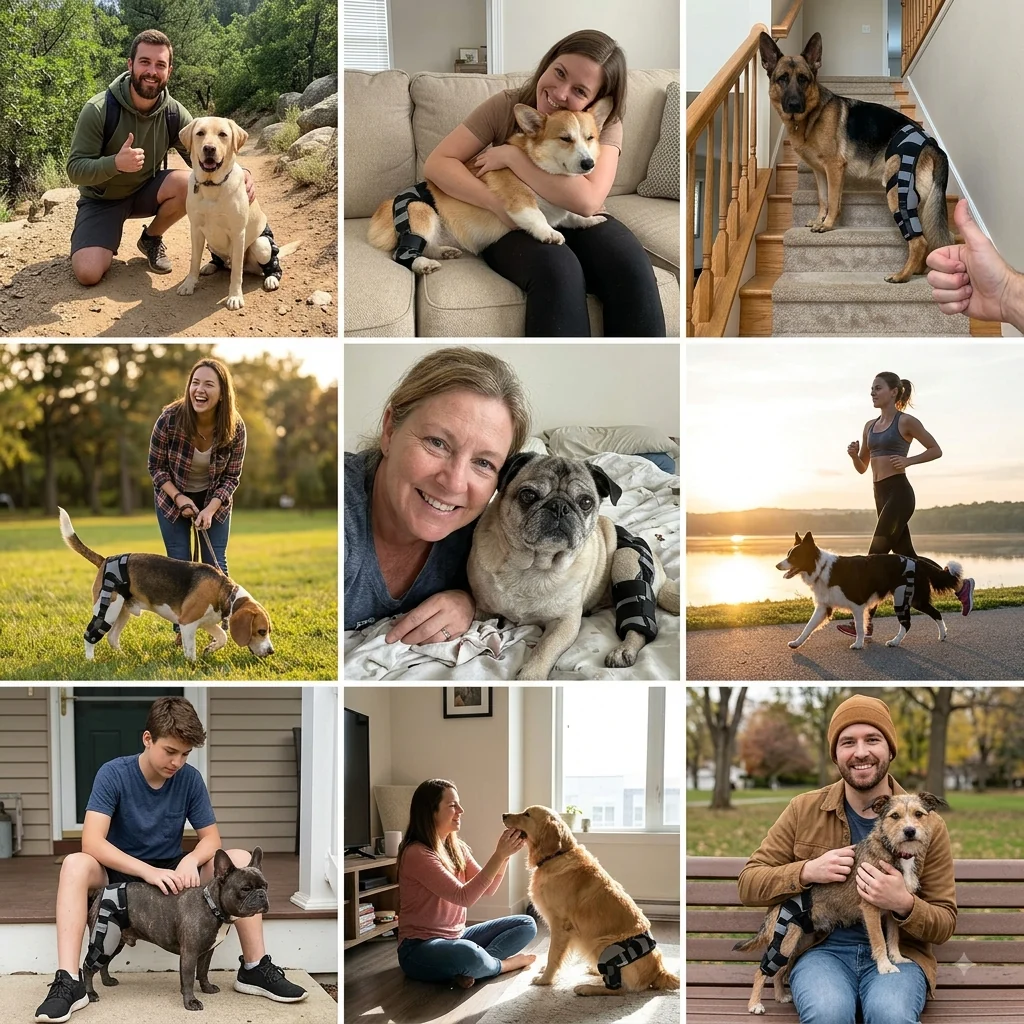
I started fitting the final design on my own rehab patients.
Bailey — a nine-year-old Lab whose owner had been quietly saving toward surgery for two years — trotted her first full loop of the dog park five weeks in. Her owner called me in tears. Not about the money. Because Bailey was running.
A retired K9 handler wrote us a letter. "He's stealing socks again," he said. "I didn't realize how much of him I'd been quietly losing until I got him back."
Before we went public, I ran a structured 90-day evaluation: 114 dogs aged 4-13, all with hind-leg lameness for at least six months, supervised through my rehab practice. No other treatment changed. One variable: DynaPaw on every walk.
- At 30 days: average visible limping episodes fell from 8 a day to 2
- At 60 days: 94% of owners reported their dog "noticeably more playful" in daily life
- At 90 days: average owner-rated mobility hit 8 out of 10 — up from 3 at baseline
- 86% of owners kept the brace in daily use after the evaluation ended — on their own dime
Those aren't miracles. They're what happens when you address all four stages at once.
WHAT REAL USERS ARE SAYING
Donna K.
- Phoenix, AZ
Purchased 1 DynaPaw Dual-Leg Brace


Donna's 9-year-old Lab is chasing squirrels again...
"Bailey started limping after fetch last spring and it never went away. The vet quoted us $4,800 for surgery we could not swing. Tried the pills, tried resting her - she would be worse again the second she moved. Bought this as a last resort. Five weeks later she is doing full loops at the dog park and jumping into the truck bed by herself. Our vet asked what changed. I showed him the brace, and he took a picture of the box."
Marcus T. - Detroit, MI
Purchased 1 DynaPaw Dual-Leg Brace
Marcus's German Shepherd is taking the stairs again...
"Duke's back leg had been giving out on the stairs for almost 2 years. It got so bad we talked about carrying a 90-pound Shepherd out to the yard every morning. Started him in this brace and within 3 weeks he was taking the stairs like a puppy. The vet kept pushing anti-inflammatories that killed his appetite. I'd rather strap this on for his walks than keep him on pills. Only wish I found it sooner."
Jennifer R. - Tampa, FL
Purchased 1 DynaPaw Dual-Leg Brace
Jennifer's senior girl gets on the couch by herself again...
"13 years of fetch wrecked my girl's knees. By dinner she couldn't get up off her bed without whimpering, and stairs were completely out. They wanted to start her on stronger meds and I was not doing that to her liver. She's worn her DynaPaw on every walk for 2 months. The limp is down probably 80% and she got on the couch by herself for the first time in a year. Worth every penny."
THE PRICE THAT'S EMBARRASSING THE SURGERY INDUSTRY
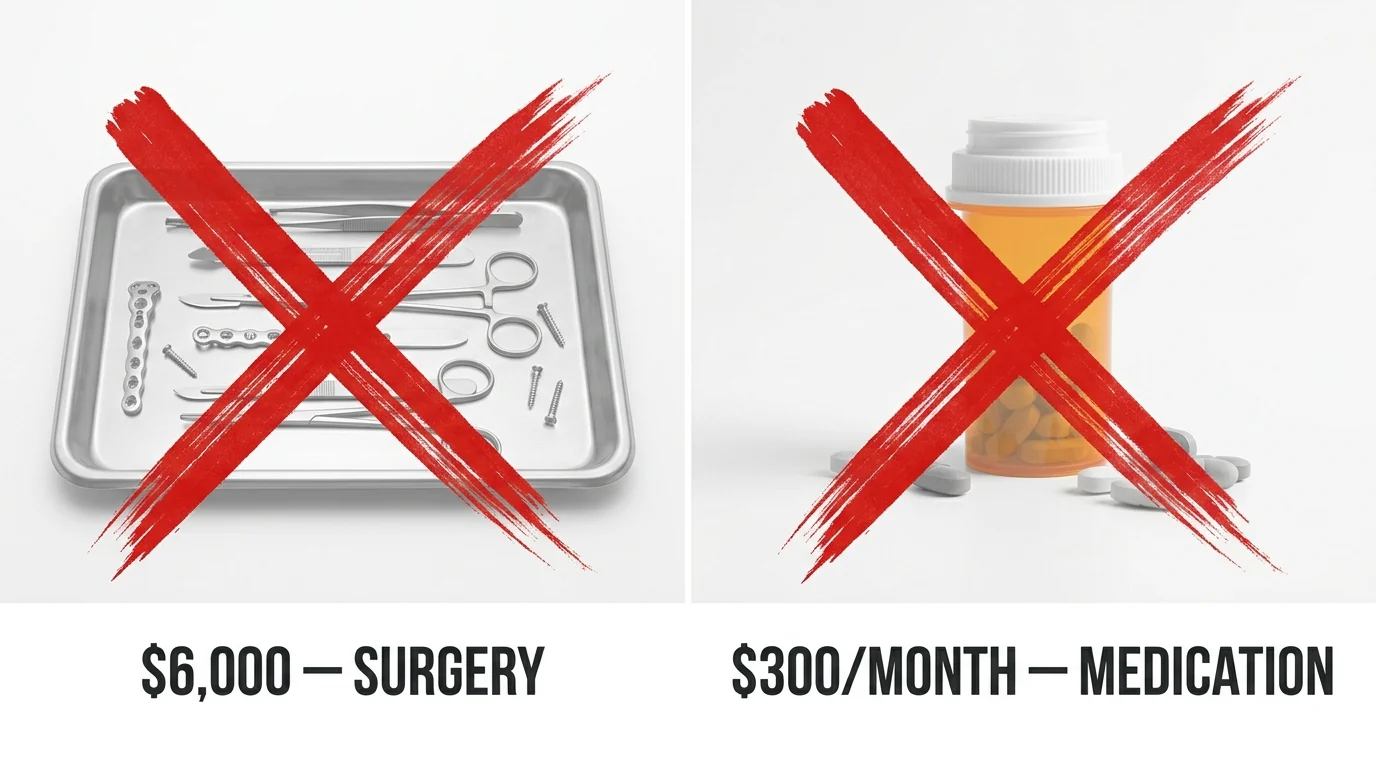
Here's what fixing a dog's failing knee costs in America right now:
TPLO surgery: $4,850 per knee, on average. General anesthesia, the bone cut and plated, 8-12 weeks of crate rest — and up to half of dogs eventually need the other knee done too.
Lifetime pain medication: $1,200/year. Plus regular bloodwork to watch the liver and kidneys. It dulls the ache — it doesn't tighten a single ligament fiber.
Custom-cast orthotic brace: $1,400 per leg. Casting appointments, weeks of waiting — and it only supports one leg, while the other one quietly starts to go.
Joint chews and supplements: $40–80/month. Fine for cartilage. Useless against a stretched ligament.
DynaPaw — the first and only dual-leg support system that addresses all four stages of Ligament Creep, veterinarian-designed, made in the USA:
$87.75, complete. One time.
Just $0.97 a day across the first three months. Less than a bag of treats.
Less than one office visit.
One brace. Two minutes before each walk. That's it.
WHEN YOU THREATEN A $38 BILLION INDUSTRY, THEY NOTICE

Within weeks of DynaPaw reaching real numbers, the calls started.
A former colleague — now consulting for a veterinary surgical-device group — pulled me aside at a conference. "Sam, you're stepping on toes. Be careful."
Then came the letters. Three law firms. All representing "concerned parties in the veterinary orthopedics space." All suggesting, in careful legal language, that I should reconsider what I was publishing about surgical complication rates and costs.
Then our medical-grade neoprene supplier — a company we'd worked with for two years — suddenly couldn't fulfill our orders. No explanation. Corporate decision.
They can't patent
what I built. They can't buy me out. So they're trying to make it
expensive and difficult to keep going.
My response is this page. And the 483 braces we still have at $87.75.
THE 90-DAY "RUNNING AGAIN" GUARANTEE 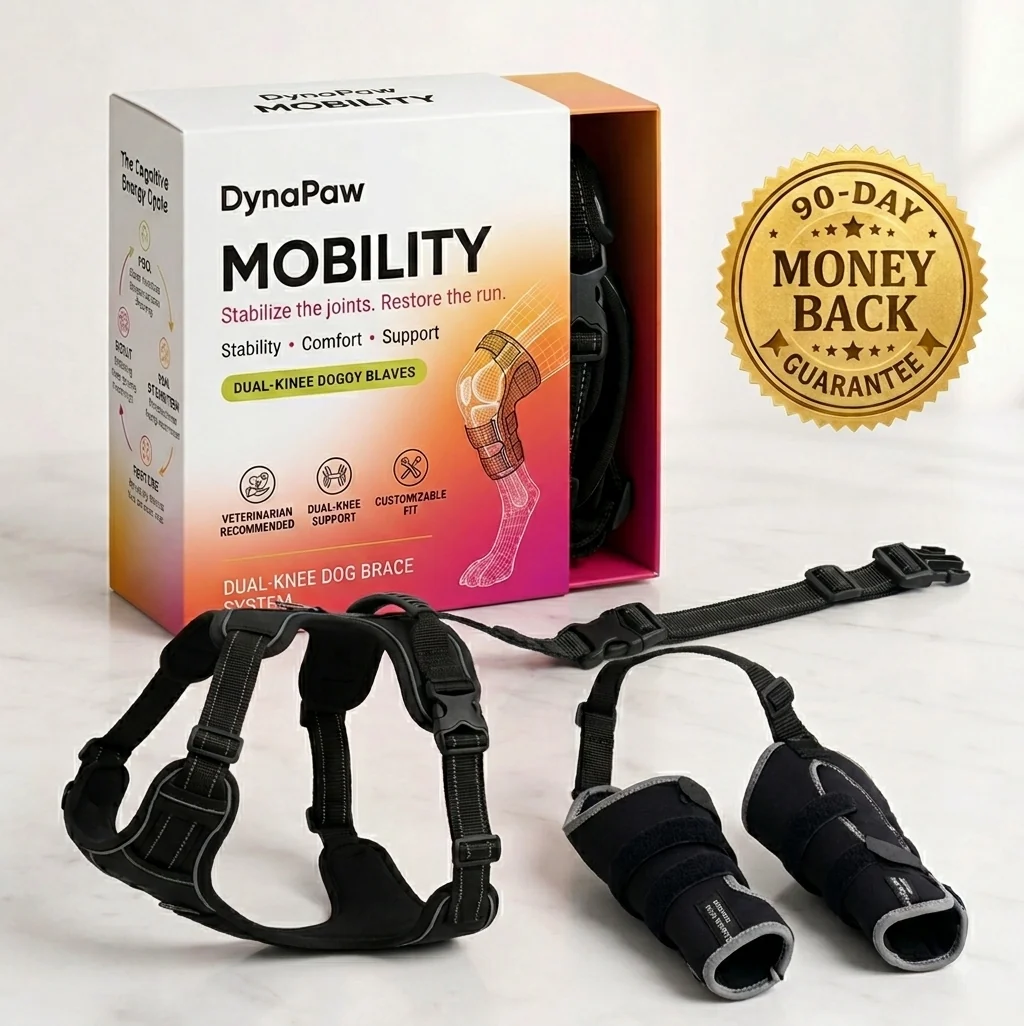
Strap DynaPaw on for every walk for 90 days.
If your dog isn't moving easier, playing longer, taking the stairs without doing math — if you don't catch yourself thinking "I haven't seen the limp in weeks" — write us one email.
We refund every penny. No forms. No store credit. No questions. Even on a well-worn brace.Even on a well-worn brace.
Why am I this confident?
Because in our entire evaluation, fewer than 1 in 100 owners asked for a refund.
And most of those had already ordered a second brace for their other dog.
THE CATCH — AND IT'S REAL
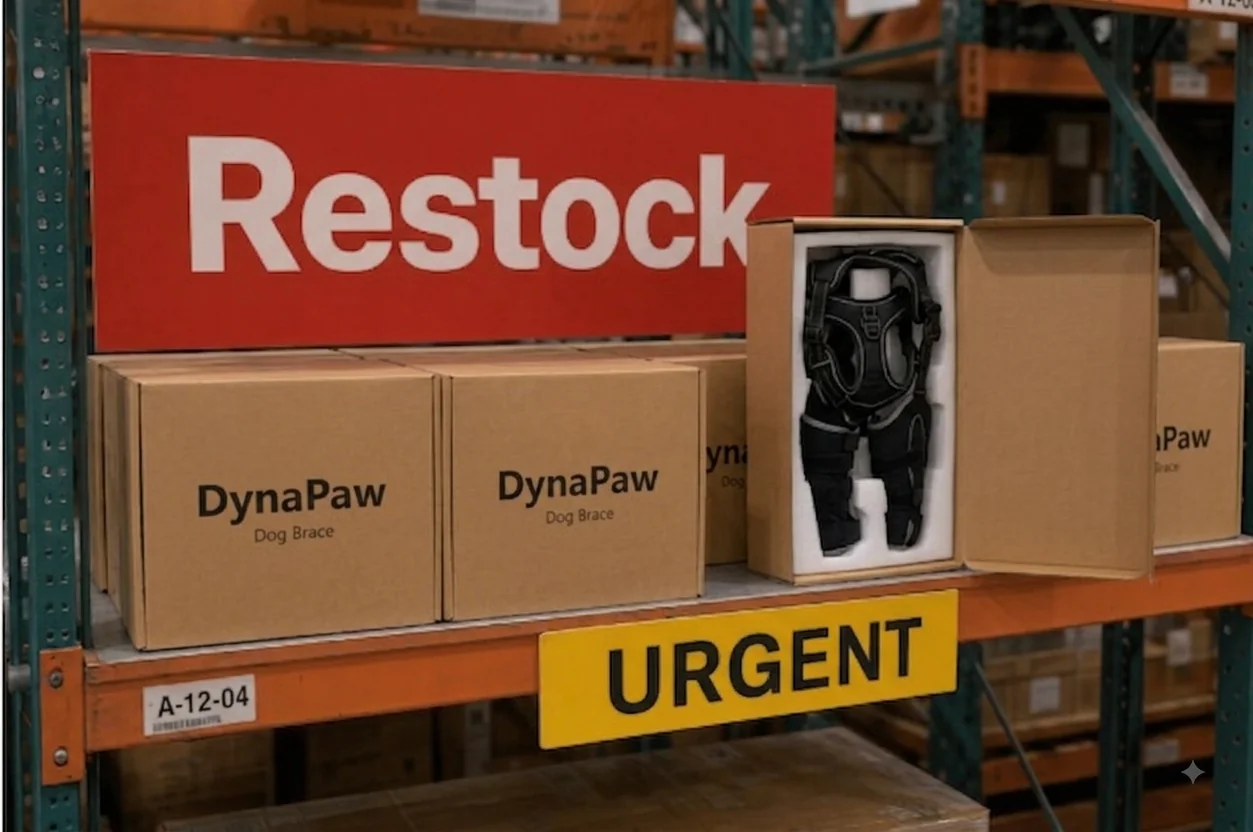
We manufacture in small batches, in the USA, in five sizes — from 8-pound terriers to 75-plus-pound shepherds.
The current run is 483 braces.
When it's gone, the next batch ships in six to eight weeks - at the retail price of
$135.
Right now, for readers of this article:
$87.75
.
35% off retail — with free shipping from our US warehouse and the "From Stiff to Spry" canine mobility guide ($49 value) included free. Only available at this price until our current batch runs out. Remember the supplier I told you about — the one that suddenly couldn't fulfill our orders after we started getting attention? We're still fighting to secure the next production run. We don't know yet what it will cost. What we know is that $87.75 won't be sustainable much longer — not with the legal bills, not with the supply chain fights, not with everything they're throwing at us to make us disappear.
THE CHOICE YOU'RE MAKING RIGHT NOW
Option 1: Keep doing what you're doing.
Keep ignoring the signs. Keep telling yourself it's just age, just a long walk, just a bad week.
Keep going until the ligament finishes tearing — until the limp doesn't fade by morning anymore, until the ball rolls past and your dog just watches it, until "wanna go for a walk?" stops getting an answer.
Until you're sitting in a surgical consult being handed an estimate for a
$4,850 operation — general anesthesia, a bone cut and plated, twelve weeks in a crate — with up to a one-in-two chance the other knee goes next.
Until the dog who used to meet you at the door can't get up off the bed to try.
This is your dog. Your shadow. The one who's been there through everything — every move, every hard year, every ordinary Tuesday.
And right now, today, you can still do something about it.
Option 2: Try the thing that addresses the actual cause.
Clip on the leash tomorrow with a reason to believe this doesn't have to be your dog's story.
Address all four stages of Ligament Creep — dual-leg stabilization, targeted compression, protected motion, on every single walk.
Stay in the window. The one that's still open. The one where the ligament can still heal short and tight.
90 days. Full refund if nothing changes. Not because we think you'll ask —
but because we know you won't.
Your dog's next five years are worth
$0.97 a day. Every walk you have left together is worth two minutes of strapping in.
And the dog you've been quietly missing — the one who sprinted for the ball, who took the stairs in two jumps, who never once let you walk out of sight — is still in there.
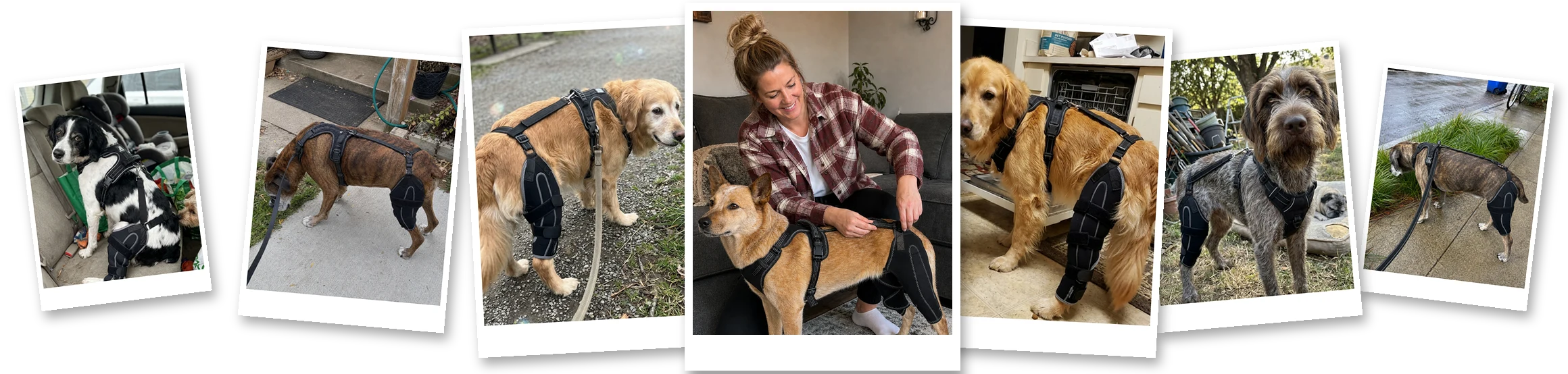
Ships Today · Free US Shipping · 90-day money-back guarantee — even on a well-worn brace
⚠️ THIS FLASH SALE PRICE EXPIRES IN 72 HOURS ⚠️
After that, the price is
$135. And the popular sizes sell out first.
With everything I have,
Dr. Sam Lyle, DVM Certified Canine Rehabilitation Specialist · Founder, DynaPaw
P.S.
— Scout is in the yard right now. Eleven years old, tennis ball in his mouth, waiting for me to finish this sentence. Two years ago I was carrying him up the porch steps. Now he takes them in two jumps again. That could be your dog in a few weeks. But only if you act before this batch sells out.
P.P.S.
— DynaPaw is the only brace we know of that supports both hind legs at once. That matters, because up to half of dogs who injure one knee injure the other within two years — the "good" leg quietly does double duty the entire time. Supporting the standing leg isn't a bonus feature. It's the whole point.
P.P.P.S.
— Yes, we've received legal
letters. Three, so far. I'm not stopping.